

Best Aquatic Weed Harvesters for Lakes and Waterways
Aquatic weed harvesters are the most effective way to remove large amounts of vegetation from lakes, rivers, and canals. While small areas can be cleared manually, most waterways require mechanical equipment that can cut, collect, and remove plant material efficiently.
The best solution depends on the size of the waterbody, the type of vegetation, and how much material needs to be removed.
Mechanical harvesting has been used for decades to manage aquatic vegetation in lakes and waterways around the world.
Aquatic weed harvesters are widely used by municipalities, lake associations, and contractors to maintain navigable and healthy waterways.
Types of Aquatic Weed Removal Methods
Manual removal (small-scale use)
Manual tools like weed cutters and rakes can be effective for small areas such as around docks, swimming areas, or shorelines.
- Low cost
- Good for limited areas
- Does not remove large volumes of material
- Temporary solution
Manual removal works best when the goal is quick, localized cleanup rather than long-term management.
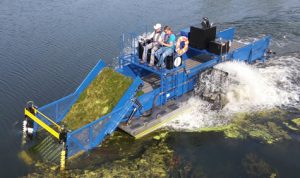
Mechanical aquatic weed harvester removing vegetation from a lake
Mechanical aquatic weed harvesters (large-scale use)
Mechanical weed harvesters are designed for lakes, rivers, and canals where vegetation is widespread or recurring.
These machines:
- Cut aquatic plants below the surface
- Collect the vegetation onboard
- Remove the material from the water for disposal
This process not only clears the waterway but also removes nutrients tied up in plant material, which can help improve water quality over time.
Mechanical harvesting is the most effective option for maintaining usable waterways at a larger scale.
What to Look for in a Weed Harvester
Not all harvesters are the same. When evaluating equipment, it’s important to consider:
Cutting depth
The ability to reach and cut vegetation below the surface.
Storage capacity
How much plant material the machine can hold before unloading.
Offloading efficiency
How quickly the collected vegetation can be removed from the machine.
Maneuverability
The ability to operate in narrow channels, shallow water, or areas with obstacles.
Durability
Equipment should be able to handle changing water conditions and heavy vegetation loads.
Choosing the Best Option for Your Waterway
For small, private areas, manual tools may be enough.
For most lakes, municipalities, and managed waterways, mechanical harvesting provides a more reliable and long-term solution. It allows operators to remove large volumes of vegetation quickly while improving access, flow, and overall water quality.
Mechanical harvesters are especially useful in areas with recurring plant growth or where maintaining navigation and recreation is important.
A Practical Approach to Weed Management
In many cases, the most effective strategy is a combination of methods.
Manual tools can be used for touch-up work in smaller areas, while mechanical harvesting handles the larger, more demanding portions of the waterway.
This approach keeps waterways clean, usable, and easier to maintain over time.
Where Equipment Fits In
Large-scale aquatic weed harvesters are built specifically for real-world conditions — including varying water depths, dense vegetation, and changing environments.
Companies like Aquarius Systems design and manufacture this type of equipment to support municipalities, lake associations, and contractors responsible for maintaining waterways.
Summary
- Manual removal works for small, localized areas
- Mechanical harvesting is the most effective solution for larger waterways
- The best equipment depends on your specific conditions and goals
Managing aquatic vegetation is not a one-size-fits-all process, but with the right approach and equipment, lakes and waterways can be kept clean, accessible, and healthy.
Frequently Asked Questions
What is the best way to remove lake weeds?
Mechanical harvesting is the most effective method for large lakes because it removes both the plants and the nutrients they contain.
Do weed harvesters remove roots?
Most harvesters cut vegetation below the surface but do not remove roots. However, repeated harvesting helps control regrowth over time.
Is mechanical harvesting better than herbicides?
Mechanical harvesting removes plant material from the water and does not introduce chemicals, making it a preferred option in many waterways.
</>