
Sometimes an idea makes perfect sense with the information available at the time.
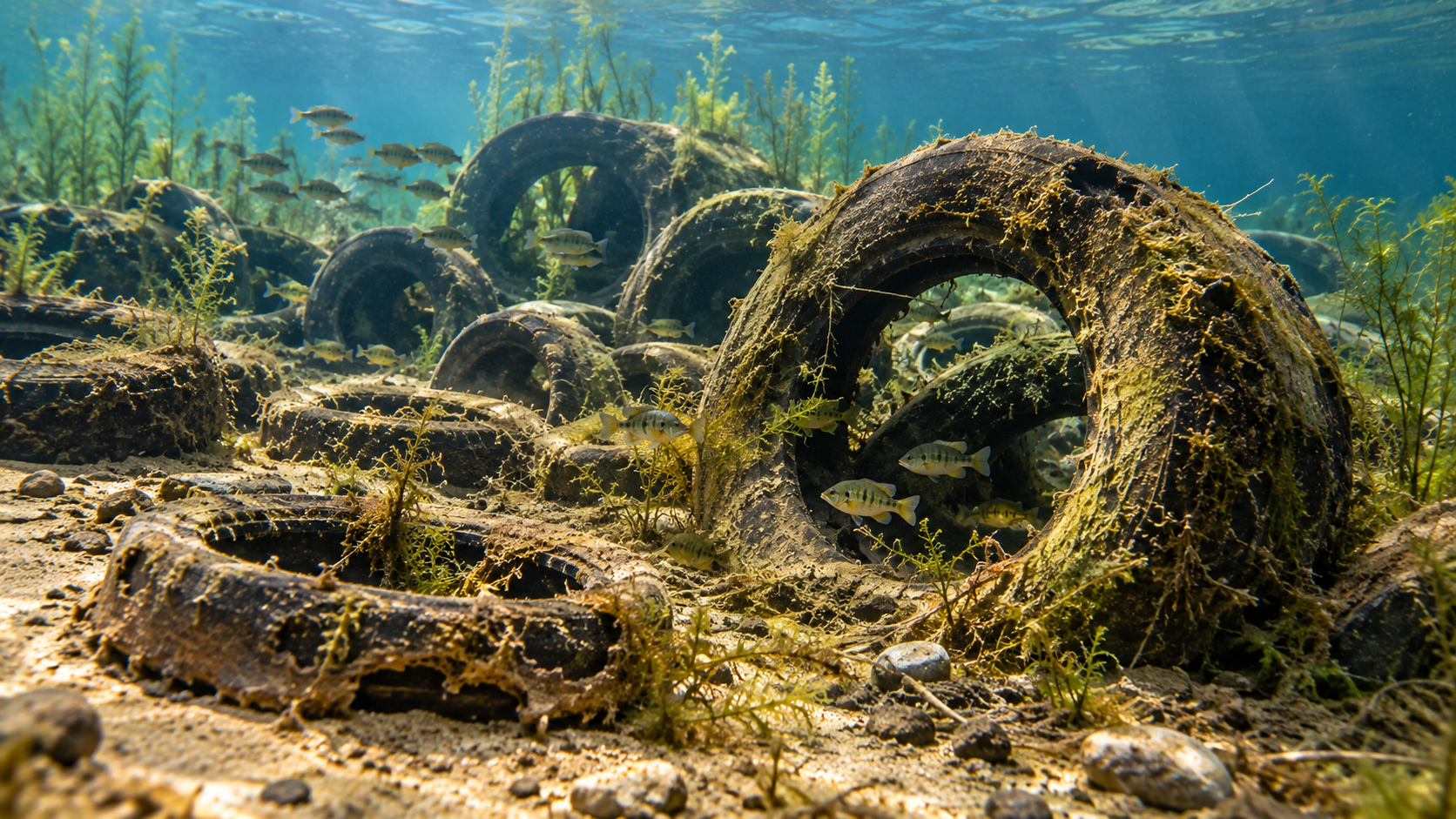
In 1994, researchers published the results of an experiment in concrete-lined canals in California and Arizona. Lining the canals helped conserve water, but it also eliminated habitat used by fish and other aquatic organisms. Their solution was innovative: build artificial habitat from discarded automobile tires.
And it appeared to work.
Areas containing the tire reefs had three times the density of aquatic invertebrates and 20 times the density of fish compared with typical sections of the canals. At the time, discarded tires seemed to solve two problems at once: keeping waste out of landfills while restoring lost aquatic habitat.
More than 30 years later, however, we know considerably more about what happens when tires spend years in an aquatic environment.
What We Didn’t Know About Tires
Tires aren’t simply rubber. They contain chemicals and metals that can make their way into the environment as tires wear and break down. Research has since found that some tire-related chemicals and particles can be harmful to aquatic life.
And the concerns aren’t limited to chemistry. During the 1960s, ’70s and ’80s, hundreds of thousands of tires were intentionally placed in waters off Florida to create artificial reefs. Over time, many broke loose, becoming marine debris and damaging natural habitat. Today, projects are underway to remove thousands of these legacy tires.
The people who created these reefs weren’t trying to harm the environment. Quite the opposite. They were trying to improve it. They simply didn’t have decades of additional research available to them.
When Our Understanding Changes
 Tires aren’t the only example of how environmental practices can change as we learn more. Herbicides once approved for controlling aquatic weeds were later removed from use after concerns about their potential effects on human health and the environment.
We have seen the same evolution with chemicals used in Agent Orange during the Vietnam War. What was once widely used was later linked to serious health and environmental concerns, leading to restrictions and discontinued uses.
The point isn’t that everything we use today will eventually prove harmful. It’s that science continues to evolve. What seems acceptable based on what we know today may look very different when we have decades of additional research to consider.
Managing With What We Know Today
There is rarely one answer for managing a lake or waterway. Chemical treatment, mechanical harvesting, biological controls, physical removal and sometimes simply leaving an area alone can each have a place depending on the waterbody, the species involved and the management objective.
That’s why asking “What are we trying to accomplish?” can be just as important as asking “What should we use?”
The 1994 tire reefs are a fascinating reminder of how environmental management evolves. Researchers saw a problem, developed a solution and measured real benefits. They weren’t necessarily wrong about what they observed. We simply know things today that they couldn’t have known then.
Good environmental stewardship means continuing to learn, asking questions and being willing to change our approach when new information gives us a reason to do so.