

Saving Our Wetlands A Message from our Leader: Initiatives and Industries to Control Aquatic Invasive Species Invasive Species Pose Major Global Threat Wetland Conservation and Restoration U.S. Wetlands Lose Protection Upcoming Conferences Washington State Lake Protection Association 36th Annual Conference California Lake Management Society 38th Annual Conference Florida Aquatic Plant Management Society 47th Annual Conference

Mechanical control methods involve the complete or partial removal of plants by mechanical means, including: harvesting, shredding, mowing, rototilling, rotovating, and chaining. These management techniques for plants rarely result in localized eradication of the species, but rather, reduce target plant abundance to non-nuisance levels. Mechanical Harvesting – A mechanical aquatic harvester (harvester) is a type
Oceans are filled with millions of tons of plastic. A 2021 study estimated that 80% of it was carried there by rivers. While many ocean-cleaning efforts have focused on trash that’s already made it to the high seas, river cleanups offer a way to intervene sooner. When a plastic bag is swept down a storm

The City of Cape Canaveral, Embry-Riddle Aeronautical University, and Stetson University, along with city and county partners are working on a solution to help stop flooding and improve water quality in Cape Canaveral. Researchers say plans include designing and building special channels called bioswales that to redirect stormwater that would cause flooding. Native, water-friendly plants
Marine debris is a global problem that threatens the health and safety of oceans and coastal waterways. Marine debris can damage sensitive habitat that supports fisheries and can harm protected species. Marine debris also has economic impacts. These impacts are felt by those whose livelihoods are linked to the sea, yet in many cases the
A new study from researchers at the Rochester Institute of Technology says that nearly 22 million pounds of plastic debris are entering the Great Lakes from the U.S. and Canada each year. Half of that plastic is going into Lake Michigan, followed by Lake Erie, Lake Ontario, Lake Huron and Lake Superior. The amount of

The “pristine” Charleston estuary waters in South Carolina, are in worse shape than most people think. At least 7- ½ tons worse. That’s how much plastic is estimated to be breaking down in the tide and waves of Charlestown Harbor, its tidal rivers and creeks. The total comes from a study by a research team

Around the world, people dump about 20 million tons of plastic into the ocean every year, much of it in the form of flyaway plastic bags. This waste doesn’t get magically swallowed by the ocean–it lingers indefinitely, posing a threat to marine life and to human health. Picking up garbage in the ocean is an
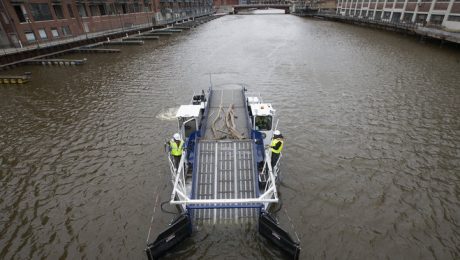
If there’s a cooler name than the Lynyrd Skymmr for any piece of heavy equipment in America, Jim Stingl would like to hear it. Milwaukee’s river skimmer is back on the water for the season with its rocking moniker. In 2013 the Aquarius Systems’ Trash Hunter collected 1,225 cubic yards of garbage and debris from