
Algae, including blue-green algae (cyanobacteria), can form harmful blooms that impact water quality, wildlife, and recreation. Learn how algae blooms develop and how to manage them safely.


Colorado Parks and Wildlife is investigating Johnstown officials after their attempt to treat an algae outbreak left nearly 1,000 fish dead. The Greeley Tribune reports that Parks and Wildlife spokeswoman Jennifer Churchill says a worker put a copper sulfate into the town’s reservoir this summer to treat the algae. She says chemical ended up suffocating

While invasive zebra mussels consume small plant-like organisms called phytoplankton, Michigan State University researchers discovered during a long-term study that zebra mussels can actually increase Microcystis, a type of phytoplankton known as “blue-green algae” or cyanobacteria, that forms harmful floating blooms. Zebra mussels can filter out the Microcystis with other particles, but then they spit

A national environmental organization labeled the Raccoon River one of the country’s most endangered because of toxic algae and nitrates. Des Moines Water Works called it a “catastrophe,” as the Raccoon is the major source for drinking water for a half-million Iowans. Des Moines Water Works, after dumping as much as $250,000 a year into

It’s a familiar sight to residents living on the shores of Kitsap Lake in Washington: each summer, around the beginning of June, a bright green algae begins to creep across the water. These blooms can be harmful to people and pets and have forced closures of Kitsap Lake and its beaches every year for the
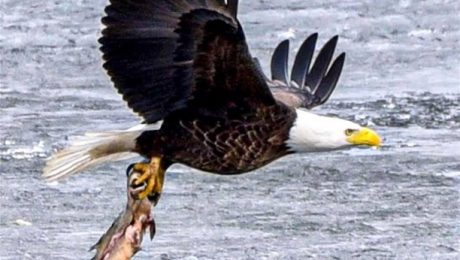
More than 25 years ago, biologists in Arkansas began to report dozens of bald eagles paralyzed, convulsing, or dead. Their brains were pocked with lesions never seen before in eagles. Birds were dying at lakes and reservoirs throughout the southeast, and at every lake Susan Wilde, an aquatic ecologist at the University of Georgia, Athens

Copper sulfate is an inorganic compound that combines sulfur with copper. It can kill bacteria, algae, roots, plants, snails, and fungi. Many local farm stores keep the product on store shelves helping to make it the most used, and the most economical algae control available for ponds and lakes. Copper Sulfate is ineffective in the

An aquatic weed harvester was used to remove macroalgae from Georgica Pond in New York from 2016 through 2018 and on a limited basis last year, an effort to inhibit harmful algal blooms, including toxic cyanobacteria, or blue-green algae. Approval has just been granted for the the mechanical harvester to be operated from June to

Algal blooms in Bednesti Lake, British Columbia, Canada, over recent years led researchers to look into how humans impact aquatic life. Overall what they found was a chain reaction, when a type of aquatic plant like a lily pad was removed, other plants disappeared too. Researchers analyzed 16 human-caused disturbances and 10 natural disturbances to

Efforts to restore Georgica Pond are proving to be successful thanks in part to the help of an aquatic weed harvester. Georgica Pond has been invaded by toxic cyanobacteria, or blue-green algae, in recent years, which can cause serious health problems. For the second consecutive year, the foundation has leased an aquatic weed harvester to


The beautiful fall colors will soon give way to barren trees and piles of fallen leaves around our yards and neighborhoods. The leaves decompose and restock the soil with nutrients and organic matter. However, those decomposing leaves may eventually make their way into lakes and rivers. They get washed down streets and into storm drains