


Biologists in Cornwall have found that chemicals released in the ocean from plastic can lead to deformities in marine animals. The study by biologists from the Centre for Ecology and Conservation on Exeter’s Penryn Campus found that plastics in the ocean can release chemicals that cause deformities in sea urchin larvae. Read More

Seagrass meadows are widespread in shallow coastal waters and are involved in trapping and binding sediment particles that form the seabed. These seagrass meadows also provide important ecosystem services and benefits, such as water quality improvement; CO2 absorption; climate change mitigation; sediment production for seafloor and beach stabilization; coastal protection; nursery and refuge areas for
Our carbon dioxide emissions are making the oceans more acidic. As we pump carbon dioxide into the atmosphere, a portion dissolves into the world’s oceans. Once there, the carbon dioxide goes through a series of chemical changes that have an acidifying effect on seawater. Trees absorb carbon dioxide from the air and through photosynthesis. Underwater
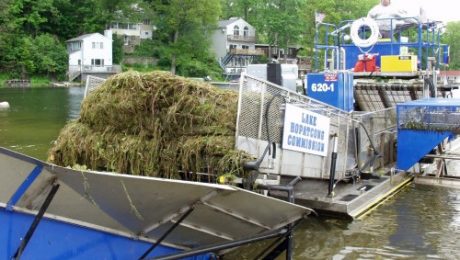
Benefits of Weed Harvesting Dr. Stephen J. Souza Lake Hopatcong Commission Environmental Consultant One of the most obvious management activities of the Lake Hopatcong Commission is the weed harvesting program. Some may view this as a simple “mowing” of the Lake. However, much more is accomplished than simply opening boating lanes and improving swimming. The

Intensive in-lake and watershed management caused Kohlman Lake, the northernmost lake in the Phalen Chain of Lakes in Minnesota, to go from a relatively turbid to a clear water state. Aquatic plants responded to the clean waters by growing up to the surface. The change in lake state and a comprehensive water quality monitoring dataset

An aquatic weed harvester was used to remove macroalgae from Georgica Pond in New York from 2016 through 2018 and on a limited basis last year, an effort to inhibit harmful algal blooms, including toxic cyanobacteria, or blue-green algae. Approval has just been granted for the the mechanical harvester to be operated from June to

Algal blooms in Bednesti Lake, British Columbia, Canada, over recent years led researchers to look into how humans impact aquatic life. Overall what they found was a chain reaction, when a type of aquatic plant like a lily pad was removed, other plants disappeared too. Researchers analyzed 16 human-caused disturbances and 10 natural disturbances to


More and more environmental groups are making noise about the devastating impact winter salting has on the environment which is raising awareness and forcing lawmakers to look at alternative solutions. In Canada alone, the country applies five million tonnes (over 110 billion pounds) of salt during an average winter. This salt contaminates ground and freshwater,

300 pounds of road salt is applied per lane per mile. It sounds like a lot! That is the industry standard! Certainly less is applied if conditions require it, but it takes many factors to determine the correct treatment to keep roadways safe in the winter months. According to to Wisconsin Saltwise, an organization designed

When the road get snow covered and icy, road crews work extra hard to keep travelers safe. However, the extensive use of salt may be damaging lakes and streams. Researchers examined 371 lakes and found that 44% are at risk of salinization, meaning there is a build of salt in the water table. This excess